





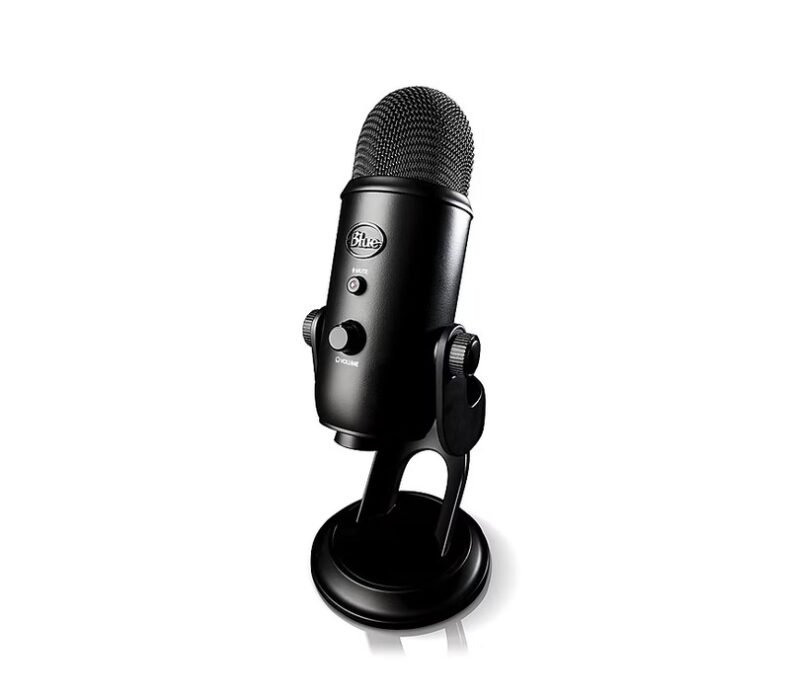
The Blue Yeti is a good USB microphone with one big catch. At around ฿6,990 in Thailand, it sounds clean in a quiet room but punishes noisy rooms hard. Best for: solo voice recording in a controlled room. Skip if: you record beside AC, fans, or thin condo walls.
| Capsules | 3 condenser. |
| Polar patterns | Cardioid, Stereo, Omnidirectional, Figure-8. |
| Sample rate | 48 kHz / 16-bit. |
| Frequency response | 20Hz to 20kHz. |
| Onboard controls | Gain, mute, polar pattern, headphone volume. |
| Connection | USB plug-and-play. |
| Weight | ~1.2 lb mic, ~2.2 lb with stand. |
| Warranty | 2-year on authorized Thailand listings. |
| Thailand street price | ~฿6,990. |
Is the Blue Yeti worth ฿6,990 in Thailand?
That depends almost entirely on your room, and nobody selling you the mic mentions that. The Yeti is a plug-and-play USB condenser with three capsules and four pickup patterns. You connect it, you talk, and the voice sounds clear and full. For a podcaster or a YouTuber recording solo, that part holds up.
Here is the catch the spec sheet hides. The Yeti’s large diaphragm is sensitive, and it has no internal noise gate. One owner who used it for two years put it plainly: it picks up everything. Every keyboard tap, every breath, the hum of the air conditioner, the fan in the corner, the neighbor’s TV through a thin condo wall. The mic does not decide what to ignore. You do, later, in software.
Design and build
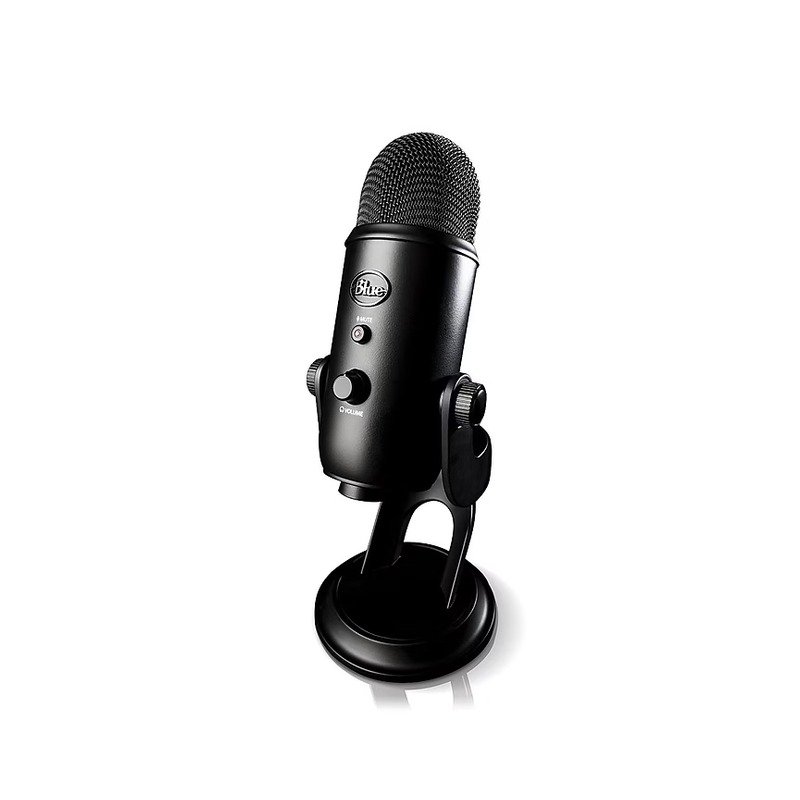
The Yeti is heavy and it feels it. The mic sits on an included metal desktop stand, and the whole thing weighs about a kilogram. That weight is reassuring on a desk and annoying the moment you want to mount it on an arm. You notice the build quality the first time you turn the gain knob. It clicks with a real damped feel, not the cheap plastic wobble you get on ฿1,000 mics.
The controls are the best part of owning one. There is a physical mute button on the front, a gain dial on the back, a polar-pattern selector, and a headphone jack for zero-latency monitoring. You can hear yourself with no delay, which matters more than it sounds when you are recording in Bangkok heat and already irritated.
One real owner complaint worth flagging. The USB jack can loosen over years of use, and the bundled cable is the first thing to fail. Owners on Pantip in Thailand have posted about ports dying after a couple of years. Treat the cable as a consumable.
We have not personally tested this unit. This review draws on verified owner reports from buyers in Thailand, Pantip threads, and long-term reviews. The pattern that shows up over and over is consistent enough to trust.
Build is solid. The cable is not.
What the sound actually delivers at this price
In cardioid mode, sat 5 to 6 inches away with a pop filter, the Yeti sounds clean and professional. The voice comes through full and clear. Reviewers describe the tone as slightly cold or sterile, which is fair, but for spoken word that neutrality is a feature, not a flaw. This is the version of the Yeti that built its reputation.
Then there is the version you actually get in a real Thai room. The Yeti records loud. Files come out hot, and you spend the first ten minutes of every edit pulling levels down. Worse, because there is no noise gate, the AC compressor kicking on mid-sentence lands in your recording at full volume. A fan two meters away becomes a constant wash under your voice.
The fix exists, and it is annoying. You set the gain low, you keep your mouth close, and you run a noise gate in software like OBS or Audacity. Owners who do this get good results. Owners who expected a mic that just works are the ones who write angry reviews. Both groups are right. The Yeti rewards effort and punishes laziness.
The counterintuitive part: the cheaper, less famous mics in this category have the exact same no-gate problem. You are not paying ฿6,990 to escape it. You are paying for the four patterns, the build, and the brand.
Great in a treated room. Difficult in a live one.
How does it compare to cheaper USB mics in Thailand?
The price gets hard to defend here. The FIFINE K669B sells in Thailand for around ฿1,290. It is a single-pattern USB condenser with the same plug-and-play simplicity and, yes, the same lack of a noise gate. For a beginner recording voice in a quiet room, it gets you most of the way for a fifth of the money.
Step up and the HyperX QuadCast runs around ฿4,500 in Thailand. It adds a built-in shock mount and a tap-to-mute top, and it is the streamer favorite for a reason. If you are buying for Twitch or gaming, the QuadCast is the more sensible spend than the Yeti at ฿6,990. SoundGuys reaches the same conclusion, steering tight budgets away from the Yeti.
So who is the Yeti actually for? Buy it if you want one good-looking mic that records voiceovers, podcasts, and meetings with no fuss, and you can give it a quiet room. Skip it if you stream in an untreated condo with a fan running, where its sensitivity becomes the problem the gain knob cannot fully solve. At ฿6,990 with a genuine Thai-warranty seller, it sits between the ฿1,290 FIFINE and the ฿4,500 QuadCast, and it earns that middle price on build and looks more than on raw sound.
If you want the full field of options at every budget, our best microphones for streaming and podcasting in Thailand roundup ranks the Yeti against everything else worth buying. For a complete audio setup, the best gaming headsets in Thailand guide covers the monitoring side.
Where the Yeti hits its ceiling
The Yeti is USB only. There is no XLR output. That sounds like a non-issue until you outgrow it. The moment you want a real noise gate, a cleaner preamp, or a proper audio chain, you cannot add an interface to the Yeti. You have to rebuy a different mic entirely. So the ฿6,990 is not a first step toward a studio. It is a complete, closed purchase.
For most people that is fine. You buy it, you record, you never go further. Just go in knowing the road ends here.
- Four pickup patterns cover solo, two-person, and room recording from a single mic.
- Clean, full voice at 5 to 6 inches in cardioid mode, professional enough for podcasts and YouTube.
- Onboard gain knob, mute button, and zero-latency headphone monitoring, all physical controls you reach without a mouse.
- Damped metal build that feels worth the money, plus a 2-year local warranty on authorized Thailand listings.
- No internal noise gate, so in a Bangkok condo the AC, the fan, and keyboard taps all land in your recording at full volume.
- USB only with no XLR path, so you rebuy rather than upgrade when you outgrow it.
- At ฿6,990 it runs roughly five times a FIFINE K669B near ฿1,290 that has the same no-gate caveat in a quiet room.
Blue Yeti specifications
Should you buy the Blue Yeti?
Buy it if you record voice in a reasonably quiet room and you want four patterns and real onboard controls in one closed, no-fuss package. It earns its place for solo podcasters and YouTubers who will put in the small effort of low gain, close mic placement, and a software gate. The build and the warranty are real.
Skip it if you record in a live Bangkok condo with the AC always on, or if ฿6,990 is your whole budget. A FIFINE K669B carries the same caveat for around ฿1,290, a fifth of the price. A HyperX QuadCast near ฿5,000 is the smarter streaming buy. The Yeti is a good mic. It is just rarely the right purchase at this price.
Does the Blue Yeti need a pop filter?
Yes, for spoken word. The Yeti’s clean sound at 5 to 6 inches turns harsh with plosives (the p and b sounds) up close. A cheap foam or nylon pop filter sold in Thailand for under ฿200 fixes it and is the single best small upgrade you can make.
Why does my Blue Yeti pick up so much background noise?
Because it has no internal noise gate and a sensitive large diaphragm. This is normal Yeti behavior, not a defect. Lower the gain, sit closer in cardioid mode, and add a software noise gate in OBS or Audacity. In a Bangkok condo, turning the fan off while recording makes a bigger difference than any setting.
Is the Blue Yeti good for streaming on Twitch?
It works, but the HyperX QuadCast at around ฿4,500 to ฿5,500 in Thailand is the better streaming buy. It has a built-in shock mount and a tap-to-mute top the Yeti lacks. The Yeti’s strength is flexibility across recording types, not streaming specifically.
How do I avoid buying a fake Blue Yeti in Thailand?
Buy from an authorized listing that includes the sealed box and a 2-year warranty. Owners on Pantip in Thailand have reported box-swapped units from some shops. Stick to an authorized seller or a high-rating shop, and confirm the warranty is ประกันศูนย์ before you pay.

Karn is ElectroThailand's lead gaming and computing editor. He covers gaming PCs, GPUs, CPUs, gaming peripherals, and everything in the PC building and esports space. With years of competitive gaming experience and a deep understanding of hardware benchmarks, Karn helps Thai gamers build smarter rigs without overspending.