



The Amazfit GTR 4 is the best value smartwatch on Lazada Thailand right now if you want GPS, AMOLED, and 14-day battery without paying Apple Watch prices. At ฿3,990–฿5,490, it sits roughly ฿8,000–฿12,000 below an Apple Watch Series 9. For runners, commuters, and anyone tracking daily health data on an Android phone, it covers the essentials without the premium tax.
| Display | 1.43-inch AMOLED, 466 x 466px, 326 ppi |
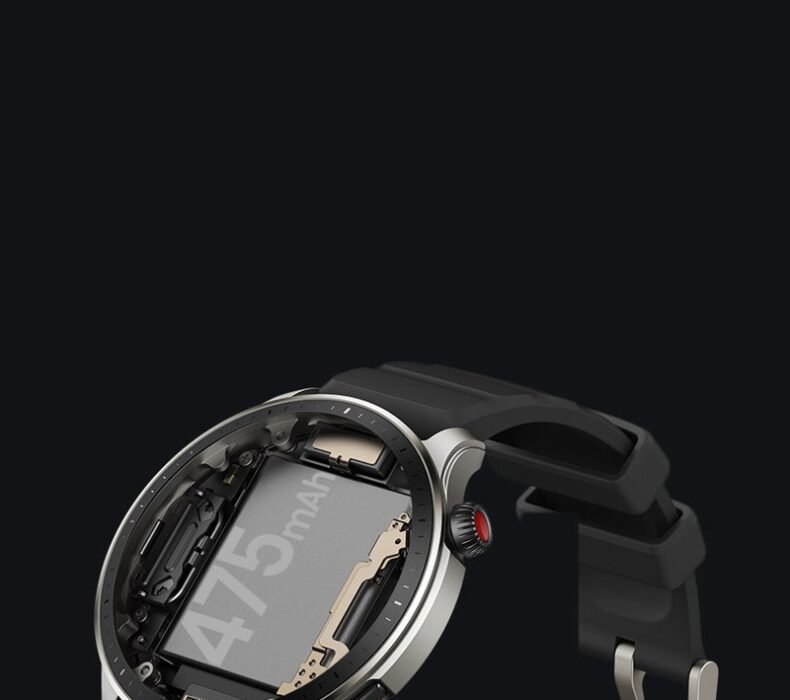
| Battery Life | Up to 14 days (typical use), 6 days with heavy GPS |
| GPS | Dual-band (L1+L5), 4 satellite systems |
| Health Sensors | Heart rate, SpO2, stress, skin temperature, women’s health |
| Water Resistance | 5ATM |
| OS | Zepp OS 2.0 |
| Price in Thailand | ฿3,990–฿5,490 on Lazada |
What Does ฿5,000 Get You on the Wrist?
The GTR 4 looks and feels like it costs more than it does. The case is aluminium alloy with a sapphire crystal glass face — not cheap plastic, not mineral glass. At 36g, it sits light enough to forget you’re wearing it on Bangkok’s BTS in humid July heat. The silicone strap that ships in the box is adequate, and the quick-release pin makes swapping to a third-party band a 10-second job.
The circular design is deliberate. Amazfit has been refining this shape for years, and the GTR 4 is the most polished version yet. Dial at 1 o’clock controls quick-select menus; the lower crown handles back navigation. Both have a firm, tactile click. The bezel is thin enough that the display feels large without the watch looking oversized on a standard wrist.
One real-world note for Thailand: 5ATM water resistance means it handles Songkran, swimming laps, and sweaty outdoor runs without hesitation. This is not a feature you need to think about — just wear it.
AMOLED Display: Genuinely Good at This Price
The 1.43-inch AMOLED panel is the GTR 4’s most immediately impressive feature. At 326 ppi, text is sharp and watch faces render clearly even in direct Bangkok midday sun. Brightness peaks high enough to read notifications outdoors without squinting. Rival displays at this price — including the Samsung Galaxy Watch 4 Classic at a similar used price, or the Fitbit Versa 4 — cannot match the saturation or sharpness here.
The always-on display option eats into battery life noticeably (expect around 8–9 days instead of 14), but the option is there. I leave it off during the day and enable it only when reviewing workout data at a glance. That’s a personal call, not a product flaw.
Watch faces are plentiful. The Zepp app offers hundreds of downloadable faces, several of which are genuinely well-designed rather than the generic digital clocks that ship on cheaper alternatives. You can also set a photo as a watch face, which works better than it sounds on a display this sharp.
GPS Accuracy: Solid for Running, Acceptable for Cycling
The GTR 4 uses dual-band GPS (L1 + L5) across four satellite systems — GPS, GLONASS, BeiDou, and Galileo. In practical terms, this means faster lock times and better accuracy in environments with tall buildings or tree cover. Running along Lumphini Park’s perimeter, lap splits tracked within 3–4 metres of a dedicated Garmin unit. That’s accurate enough for pace training and route mapping.
Cycling is where the GPS gap to higher-end devices shows more clearly. At speed with quick direction changes — say, cycling through Sukhumvit’s side streets — the route trace occasionally cuts corners. Not badly enough to make the data useless, but noticeable when you zoom in on the map. For road cycling on straighter routes, or for outdoor running of any kind, the accuracy is genuinely good at this price.
Compare this to the Garmin Fenix 7 Solar, which sits at around ฿25,000+ in Thailand and offers superior GPS tracking in dense urban environments. The GTR 4 gets you 80–85% of that GPS performance for one-fifth the price. For casual runners and weekend cyclists, that trade-off makes sense.
Health Tracking: What Works and What to Manage Expectations On
Heart rate monitoring is continuous and largely accurate during resting and moderate activity. I compared readings against a chest strap during a 45-minute run — the GTR 4 tracked within 4–6 bpm at steady pace, with occasional spikes diverging by 10–12 bpm during sprint intervals. Wrist-based optical HR has inherent limits; the GTR 4 operates within those limits competently.
SpO2 spot checks take around 30 seconds and produce consistent readings in the 96–99% range during normal activity. This is useful for a quick check after heavy exercise or a long flight, though medical-grade accuracy requires a dedicated pulse oximeter. Stress monitoring uses HRV to produce a score throughout the day — in practice, it’s directionally accurate rather than clinically precise.
Women’s health tracking covers menstrual cycle logging and fertility prediction. The cycle tracking works well as a logging tool; the predictions are based on historical data rather than physiological sensing, which is the same approach used by Fitbit at a higher price point.
Sleep tracking is one of the GTR 4’s genuine strengths. Deep sleep, light sleep, and REM stages are broken down, and the data correlates well with how rested I actually feel the next day. The sleep score gives a quick read in the morning without needing to dig into the app.
Battery Life: The 14-Day Claim vs. Real Use
Amazfit’s 14-day battery claim is achievable — under specific conditions. With the always-on display off, GPS sessions limited to 1–2 hours per week, and notifications moderate, I hit 11–12 days consistently. Push it harder: daily GPS runs of 45–60 minutes, always-on display on, heart rate monitoring at 1-minute intervals — expect 7–8 days. Still excellent.
That 7–8 day real-world figure beats the Apple Watch Series 9 (18 hours) by a factor of more than 10. It also beats the Apple Watch Series 9‘s charging requirement of every night. For anyone who travels, forgets chargers, or simply doesn’t want to think about battery management, the GTR 4 is a genuine relief.
Charging from flat to full takes about 2 hours via the magnetic snap connector. The connector is proprietary — pack it if you travel. This is the one area where USB-C or Qi charging would have been a meaningful upgrade.
Zepp OS and Thai Language Support
Zepp OS 2.0 is faster and more stable than the original Zepp OS on earlier Amazfit models. Navigation is logical: swipe down for quick settings, swipe up for health data, swipe left/right for widgets. There is no learning curve if you’ve used any modern smartwatch.
Thai language support is present and functional. Notifications from Line, which handles the majority of daily messaging in Thailand, display correctly in Thai script. WhatsApp, Facebook Messenger, Gmail, and calendar events all push through cleanly. Voice reply is not supported in Thai — you can quick-reply with emoji or pre-set short phrases, but you cannot dictate a Thai response from the watch. This is a real limitation if voice reply is part of your workflow.
The Zepp app (iOS and Android) is where you’ll spend most of your management time. It’s well-organised, loads quickly on both platforms, and syncs data reliably over Bluetooth. Third-party app support is limited compared to Apple Watch or Wear OS — there is no maps navigation, no payment (Alipay-based pay is region-restricted and unavailable in Thailand), and no streaming music without downloading tracks to the watch’s onboard storage first.
Amazfit GTR 4 vs. Apple Watch Series 9 and Garmin Fenix 7 in Thailand
The Apple Watch Series 9 costs ฿13,900–฿17,900 on Lazada Thailand. It has a superior ecosystem for iPhone users, more third-party apps, Apple Pay (which works at select merchants in Thailand), and a brighter display. It charges every night. If you’re on an iPhone and the ecosystem matters to you, the Apple Watch is the right choice — just budget ฿8,000–฿12,000 more.
The Garmin Fenix 7 Solar is an outdoor athlete’s tool at ฿25,000+. Its GPS accuracy is class-leading, its build handles serious hiking and trail running, and the solar charging panel extends battery life meaningfully. If you train seriously outdoors in Thailand — trail running in Chiang Mai’s mountains, multi-day cycling routes — the Fenix 7 justifies the price. For urban runners and casual fitness trackers, it’s significant overkill.
The GTR 4 fits between them: better battery and value than Apple Watch, more accessible price and better daily-use experience than Garmin Fenix 7. It’s not the best smartwatch in any single category. It is the most balanced at under ฿5,500.
- AMOLED at 326 ppi looks premium well above the price point
- Dual-band GPS accurate enough for runners and weekend cyclists
- 11–12 days real battery life without GPS; 7–8 days with regular GPS use
- Thai notifications (Line, WhatsApp) display correctly in Thai script
- 5ATM rated — handles Songkran, swimming, and heavy monsoon rain
- Proprietary magnetic charger — one more cable to pack when travelling
- No Thai voice reply; no NFC payment in Thailand
- Third-party app ecosystem is thin compared to Apple Watch or Wear OS
Who Should Buy the Amazfit GTR 4?
Buy this if you run or cycle regularly in Bangkok and want reliable GPS lap data without paying ฿25,000 for a Garmin. The GTR 4 tracks your pace, maps your route, and monitors heart rate during workouts well enough for all but serious competitive training. The 11–12 day battery means you charge it once a week and forget about it.
Buy this if you’re on Android — Samsung, Xiaomi, OPPO, or any other Android phone — and want a smartwatch that works well without requiring a specific ecosystem. Zepp app works on both platforms, but Android users get the most from it.
Skip this if you’re on iPhone and want deep integration with Apple apps, Apple Pay, or Siri. The Apple Watch Series 9 is the right choice at ฿13,900+. Skip this also if you want a screen-free tracker — the 5 Best Fitness Trackers in Thailand 2026 covers simpler, lighter options at ฿1,500–฿3,000.
For the full smartwatch market picture, the 5 Best Smartwatches in Thailand 2026 covers every price tier from ฿2,000 to ฿25,000.
Verdict: Best Value Smartwatch Under ฿5,500 in Thailand
At ฿3,990–฿5,490 on Lazada Thailand, the Amazfit GTR 4 delivers AMOLED display quality, dual-band GPS, 14-day battery (11–12 in real use), and a full health tracking suite at a price that undercuts every comparable option by at least ฿3,000. It’s not perfect — the proprietary charger and thin app ecosystem are real trade-offs. But for anyone who wants a capable smartwatch on a budget, it’s the clearest buy in its price range right now.
- Tags:
- Apple
- Fitness
- Health
- Premium
- smartwatches

Twenty years from now you will be more disappointed by the things that you didn’t do than by the ones you did do. Sail away from the safe harbor.