




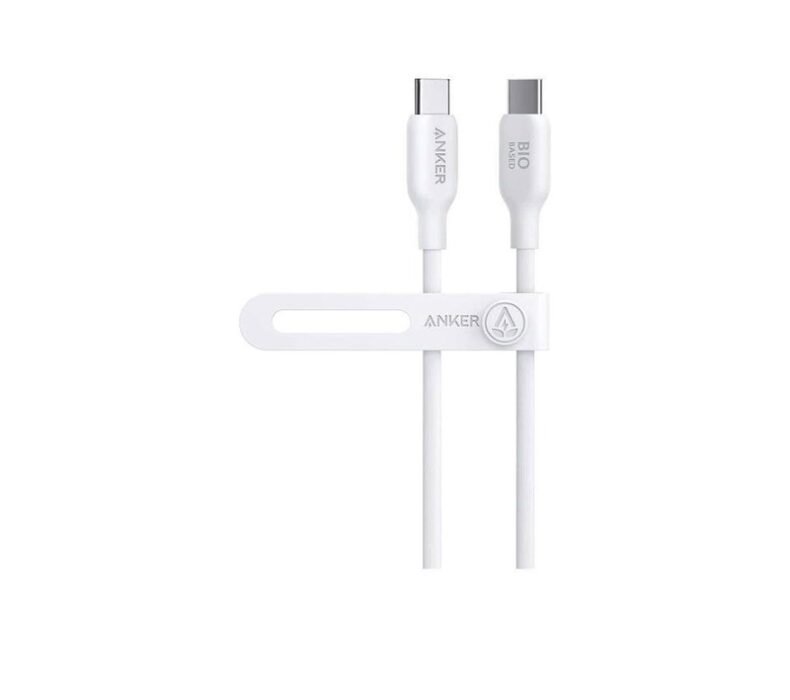
The Anker 543 USB-C Cable is the best charging cable for 140W laptop charging in Thailand right now. At ฿490 on Lazada through Anker’s official Thai store, it supports USB PD 3.1 EPR with a bio-based braided build that holds up to daily commuting and humidity far better than rubber-jacketed alternatives. If you run a MacBook Pro, a high-end ThinkPad, or any USB-C laptop that pulls over 100W, this is the one cable worth buying.
| Connector | USB-C to USB-C |
| Max Charging Power | 140W (USB PD 3.1 EPR) |
| Data Transfer | USB 2.0 (480 Mbps) |
| Length Options | 0.9m / 1.8m |
| Jacket Material | Bio-based braided (plant-derived) |
| Bend Rating | 35,000+ bends |
| Price (Lazada TH) | ฿490 |
Design and Build
The 543 uses Anker’s bio-based braided sleeve — the outer layer is partially derived from plant-based materials rather than standard petroleum plastic. In practice, it feels like any quality braided cable: slightly textured, flexible without being floppy, and far more resistant to kinking than rubber-jacketed alternatives. This matters more than it sounds for anyone who coils and uncoils a cable multiple times a day.
The braid does not fray at the ends after extended daily use, which is the failure mode you see on cheaper cables within six months of BTS commuting. Connector heads are reinforced with a stepped strain relief — the point where the cable meets the plug is the highest-stress zone, and the 543 handles it better than most cables at this price. The USB-C plugs fit snugly without wobble, which matters for 140W charging: a loose connection at high wattage can interrupt the EPR handshake and drop the charge rate mid-session.
Thailand’s combination of heat and humidity is genuinely hard on cables. Rubber-jacketed cables become sticky and eventually brittle in Bangkok apartments without airflow, especially when stored in a bag near a laptop that runs warm. After extended use in humid conditions, the bio-based braid stays consistent — the texture does not change and the flex point does not develop any hard spots. The 1.8m length handles desk use comfortably; the 0.9m is the travel pick for fitting in a laptop bag without excess.
Charging Performance
140W via USB PD 3.1 EPR is the headline spec. To actually reach 140W, you need a charger that supports EPR — Anker’s own 140W and 150W GaN chargers do, as does the Apple 140W USB-C Power Adapter, the Baseus GaN5 Pro 140W, and Ugreen’s 145W multi-port chargers available on Lazada Thailand. If you plug the 543 into a standard 65W or 100W charger, it negotiates a lower wattage automatically, which is correct behavior — the cable does not force anything, it just enables whatever your charger and device agree on.
For MacBook Pro 14-inch users in Thailand, the 543 sustains full-speed charging from a 140W EPR charger without connection drops. The MacBook Pro 14 pulls up to 96W at peak and the cable handles it continuously. MacBook Pro 16-inch users will see the same — it draws up to 140W during heavy load and the Anker 543 holds the handshake. This is where cheaper cables fail: a ฿150 unbranded cable from Lazada often doesn’t carry an e-marker chip, which is required for EPR negotiation above 60W. The Anker 543 has the e-marker chip built in.
For Android phones and tablets in Thailand — Samsung Galaxy S24, Xiaomi 14, OPPO Find X8 — the cable negotiates the correct Samsung 45W or Xiaomi 120W fast charge protocol without issues. iPad Pro (USB-C, all generations) charges at full speed. The cable is backward compatible all the way down to 5W — it works on anything with a USB-C port, regardless of charging speed.
Data transfer is USB 2.0 at 480 Mbps. That is sufficient for syncing phones, charging keyboards, and transferring small files, but not for moving large video files or connecting external SSDs at speed. The 543 is a charging cable first — if you need Thunderbolt 3/4 or USB 3.2 transfer rates alongside charging, you need a different cable for that specific use case.
Thailand Context
The Anker 543 sells for ฿490 on Lazada Thailand through Anker’s official store (ประกันศูนย์ไทย). Anker has a local Thailand presence, so warranty claims go through their local service process without international shipping. For a cable under ฿500, that is a meaningful differentiator — grey-market alternatives at this price often have no warranty and unverified power ratings. Anker Official Store on Lazada has a 4.8+ rating with thousands of transactions. If you see the same cable listed by a third-party seller at a lower price, stick with the official store for warranty coverage.
Competing options in Thailand: Baseus USB-C cables sell for ฿299–฿450 and max at 100W for most models. A 100W Baseus is the right call for phone and mid-range laptop charging — it costs less and does the job. The Anker 543 at ฿490 makes sense specifically when you have a laptop that benefits from EPR: MacBook Pro 14 or 16, Lenovo ThinkPad X1 Carbon 2023+, ASUS ROG Flow X16, Dell XPS 15 with 140W USB-C charging, or any Windows laptop rated above 100W USB-C input.
For context, the Apple 2m USB-C 240W cable sells for around ฿2,200 on Lazada Thailand. It does support higher wattages, but for a MacBook Pro that caps at 140W input, the Anker 543 does the same job at a fifth of the price. Power Mall in Bangkok and Pantip Plaza stock some branded USB-C cables, but selection is limited and prices are higher than Lazada. Lazada next-day delivery in Bangkok makes it the practical buying channel for cables.
Pros & Cons
- 140W USB PD 3.1 EPR — one cable handles laptops, tablets, and phones
- E-marker chip confirmed — EPR handshake works correctly at 140W
- Bio-based braided build survives Bangkok humidity and daily bag use
- Thai warranty through Anker Official Store on Lazada
- Backward compatible — works at any wattage from 5W to 140W
- USB 2.0 data speeds only — not for fast file transfers
- 140W benefit only realized with an EPR-compatible charger and device
Who Should Buy This
Buy this if you own a laptop that supports 140W USB-C charging — MacBook Pro 14 or 16, a high-end Lenovo ThinkPad, ASUS ROG Flow series, or a Dell XPS that pulls over 100W. One Anker 543 replaces a separate laptop charger cable and your phone cable. It handles both. If you have gone through two or three cheap cables in the past year from commuting in Bangkok, the bio-based braid on this cable holds up longer — the 35,000-bend rating is measurable and the daily bag-in, bag-out reality validates it.
Skip this if you only charge phones and tablets. A 65W or 100W cable at ฿299–฿350 on Lazada does that job and saves you ฿150–฿200. The 543’s extra capability goes unused. Skip it too if you need fast file transfers alongside charging — the USB 2.0 speeds mean plugging in an external SSD is slow. A Thunderbolt or USB 3.2 cable handles that use case; the Anker 543 does not.
Frequently Asked Questions
📋 Related: Best USB-C Cables in Thailand 2026
Verdict
The Anker 543 is the right call for anyone running 140W laptop charging in Thailand. At ฿490 with a local warranty, a certified e-marker chip, and a braid that handles Bangkok’s humidity and daily commute abuse, it covers everything a single-cable setup needs. If 140W is not a requirement for your devices, a cheaper cable does the job — but for high-power laptop charging, this is the cable to buy.

Fern writes about everyday carry tech, mobile accessories, and health gadgets for ElectroThailand. A Bangkok-based lifestyle writer with a focus on practical technology, she reviews the products people use on the BTS every morning — power banks, phone cases, cables, earphones — and the health devices that track their wellness. If it fits in a bag and improves your day, Fern has tested it.