





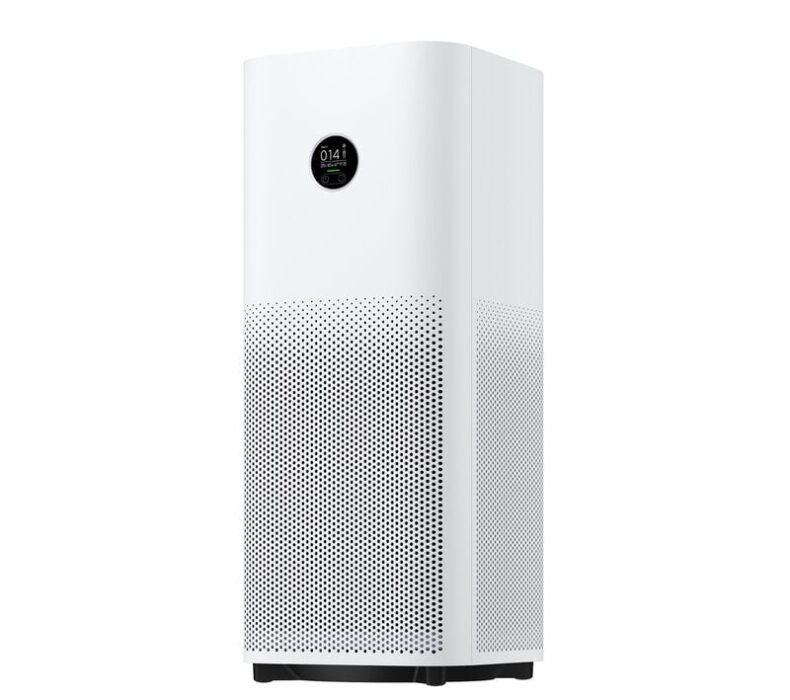
The Xiaomi Smart Air Purifier 4 Pro is the best budget PM2.5 air purifier you can buy in Thailand right now. At ฿4,490–฿5,990 on Lazada, it covers rooms up to 48m², hits 500m³/h CADR, and connects to the Mi Home app so you can check your PM2.5 readings from the other side of the condo. If you live in Chiang Mai between February and April, or anywhere near Bangkok’s expressways year-round, this machine earns its price in the first week of burning season.
Quick Specs
| CADR (Clean Air Delivery Rate) | 500m³/h |
| Filter type | HEPA H13 + activated carbon + pre-filter |
| Room coverage | Up to 48m² |
| PM2.5 sensor | Built-in laser particle sensor |
| TVOC sensor | Yes |
| Noise level | 33–64 dB (Sleep to Turbo) |
| App | Mi Home / Xiaomi Home (iOS + Android) |
| Display | OLED, shows PM2.5 reading + fan speed |
| Dimensions | 260 × 260 × 555mm |
| Price (Lazada TH) | ฿4,490–฿5,990 |
Design and Build: Does It Fit a Thai Condo?
The 4 Pro is a tall column — 555mm high, 260mm square at the base. In a standard Bangkok condo bedroom (typically 10–15m²), it sits in the corner without taking over the room. The matte white finish doesn’t collect visible dust the way glossy plastics do, which matters in Thailand’s year-round humidity. The build feels solid at this price; nothing flexes, the filter door clicks shut firmly, and the top OLED display is bright enough to read from across the room.
One practical note for Thai apartments: the air inlet runs around the base, which means it needs at least 20cm clearance on all sides. Floor-level placement is fine; just don’t push it directly against the wall or behind a sofa. The cylindrical 360° airflow design means you don’t need to point it at anything — it cleans the whole room, not just one direction.
PM2.5 Performance in Thai Conditions
The HEPA H13 filter is the reason to buy this machine. H13 captures 99.95% of particles 0.3 microns or larger — that includes PM2.5, PM10, and the fine smoke particulates that define Chiang Mai’s February–April burning season. Bangkok’s traffic pollution is a different source but the same particle size range: diesel exhaust, tyre wear, and construction dust all sit in the PM2.5 range.
At 500m³/h CADR, the 4 Pro exchanges all the air in a 30m² room roughly once every 3.6 minutes on high speed. In practice that means you can open a window briefly, close it, run the purifier on Auto, and watch the PM2.5 reading drop from 50–70 µg/m³ (hazardous range during burning season) back to under 15 µg/m³ within about 20 minutes. The laser particle sensor triggers the fan automatically when it detects a spike — so if someone cooks in an open-plan kitchen or a neighbor burns waste nearby, the machine responds without you touching anything.
The built-in TVOC sensor adds value beyond PM2.5. New furniture off-gassing, cleaning chemicals, and paint fumes are common in new Thai condos, and the TVOC display gives you a real number rather than guessing. It won’t remove all VOCs the way a dedicated carbon filter setup would, but for general household protection it’s enough.
Noise at Each Speed: Can You Sleep With It?
Sleep mode runs at 33 dB — genuinely quiet, comparable to a soft fan on low. At that level you won’t hear it over an air conditioner or a ceiling fan. Medium speed reaches around 45 dB, which is fine for daytime use in a bedroom or living room. High speed hits roughly 55 dB and Turbo (the maximum) reaches 64 dB — that’s noticeable, roughly the volume of a quiet conversation.
For bedroom use in Thailand, the practical recommendation is this: run Auto mode during the day (it manages itself based on air quality), then switch to Sleep mode at night. Sleep mode still circulates air — it just runs the fan at minimal speed. During peak burning season in Chiang Mai, overnight PM2.5 levels can drift up even with windows closed, so having the purifier active at low speed all night is the right call.
Mi Home App: Thai Language, Scheduling, and Real-Time Data
The Mi Home app (now also called Xiaomi Home) works in Thai language and supports all the features that matter: real-time PM2.5 readings, fan speed control, Auto mode toggle, a 24-hour air quality history graph, and timer scheduling. You can set it to run on a schedule — say, starting 30 minutes before you get home — or tie it to Apple HomeKit or Google Home if you’re building a smart home setup.
The app’s historical data is the genuinely useful feature. You can check what your PM2.5 levels were overnight, which tells you whether your windows are sealing properly and whether your filter is working. On a good day in Bangkok, indoor PM2.5 with the purifier running should stay under 12 µg/m³. If it’s creeping above 25 µg/m³ despite the machine running on Auto, it’s time to check the filter.
Filter Replacement Cost and Availability in Thailand
The replacement filter for the 4 Pro (model MJJSQ04TAC) is available on Lazada from Xiaomi’s official store. Pricing runs ฿650–฿850 depending on seller. Xiaomi recommends replacing the filter every 6–12 months depending on usage — in Chiang Mai during burning season you’ll hit the 6-month threshold easily if you’re running the machine daily.
Annual running cost: roughly ฿800 for one filter replacement per year under normal Bangkok conditions. If you’re in the north and running it heavily February–April, budget for two replacements a year — about ฿1,600. That’s well within reason for the air quality benefit. Filters are consistently in stock on Lazada; this isn’t a product where you’ll be hunting down parts.
Room Size Coverage for Thai Condos
Xiaomi rates the 4 Pro for rooms up to 48m². In real-world Thai condo terms:
- Studio or 1-bedroom bedroom (15–25m²): overkill in the best way — reaches clean air in under 10 minutes on Auto
- 1-bedroom living/dining area (25–35m²): well within its range on medium speed
- 2-bedroom combined open plan (40–50m²): capable, but you’ll want to keep doors between rooms open and run on medium-high
- Rooms above 50m²: step up to the Xiaomi 4 Max (600m³/h) or run two units
Most Thai condos in the 1–2 bedroom range are between 28m² and 48m², which puts the 4 Pro squarely in the right size bracket for the majority of buyers.
Xiaomi 4 Pro vs Coway AP-1512HH: Which Should You Buy?
The Coway AP-1512HH is the most common alternative at a similar price point. Key differences:
- CADR: Coway AP-1512HH is rated at 246m³/h — less than half the 4 Pro’s 500m³/h. For the same room, the Xiaomi cleans the air roughly twice as fast.
- Room size: Coway covers up to 36.9m², Xiaomi covers 48m²
- App control: Xiaomi has Mi Home app. Coway AP-1512HH has no app — it’s manual controls only.
- Filter cost: Coway replacement filters run ฿800–฿1,200 — similar to Xiaomi
- Build quality: Coway feels slightly more premium in hand; both are solid for the price
If you don’t care about app control and have a smaller room, the Coway AP-1512HH is a proven, reliable choice. If you want higher CADR, app scheduling, and real-time PM2.5 data in a larger room, the Xiaomi 4 Pro wins on value.
Thailand Price, Warranty, and Where to Buy
Current Lazada price: ฿4,490–฿5,990 from Xiaomi official and authorized sellers. Buy from the Xiaomi Official Store on Lazada for genuine Thai warranty (ประกันศูนย์ไทย 1 year). The price occasionally drops to ฿4,490 during Lazada sale events (11.11, 12.12, Mid-Year Sale).
Internationally, the 4 Pro sells for roughly USD $130–$140 on Amazon — that’s about ฿4,600–฿4,900 at current exchange rates, meaning Thai pricing is reasonable and roughly on par. No significant grey-market premium to worry about.
You’ll also find it at Power Mall and some Big C/Lotus electronics sections, but Lazada gives the best price consistency and the official store warranty is cleaner to manage if you need to claim.
- 500m³/h CADR is significantly higher than most competitors at this price point
- HEPA H13 filter captures 99.95% of PM2.5 particles — critical for burning season
- Mi Home app shows real-time PM2.5 + TVOC with 24-hour history graph
- Sleep mode at 33 dB — quiet enough for all-night bedroom use
- Filter replacements consistently in stock on Lazada at ฿650–฿850
- Turbo mode at 64 dB is loud enough to interrupt light conversations
- Tall form factor (555mm) looks out of place in very small or furnished rooms
- TVOC sensor gives a general reading, not compound-specific analysis
Who Should Buy the Xiaomi Smart Air Purifier 4 Pro?
Buy this if you’re in Chiang Mai or anywhere in northern Thailand and you want real PM2.5 protection during burning season. The 500m³/h CADR is fast enough to meaningfully clean the air in a standard bedroom or living room before AQI gets to dangerous levels indoors. It’s also the right pick for Bangkok condos near expressways, industrial areas, or any building where you keep windows closed and want to monitor air quality actively via the app.
Also worth considering if you’re upgrading from a cheaper purifier without a real HEPA filter — a lot of sub-฿2,000 machines use basic filter layers that don’t meet H13 standard and won’t capture the finest PM2.5 particles effectively.
Skip this if your room is under 20m² and you’re purely budget-focused — the Coway AP-1512HH costs about the same and does the job in smaller spaces without app complexity. Also skip it if you need something for a large open-plan area over 60m² — at that point the 4 Max is the right tool.
For more options at different price points, see our guide to the 5 best air purifiers in Thailand 2026.
Chiang Mai Burning Season and Bangkok Traffic Pollution
Between February and April each year, Chiang Mai regularly posts AQI readings above 150 (unhealthy) and sometimes above 200 (very unhealthy). The culprit is agricultural burning across northern Thailand and parts of Myanmar — the smoke sits in the valley, and without wind or rain it builds for days. Indoor PM2.5 in a sealed apartment without a purifier can still reach 40–60 µg/m³ during peak events.
Bangkok’s pollution profile is different but year-round. Traffic density on expressways like the Expressway Authority network and Sukhumvit-area congestion generates consistent PM2.5 from diesel and petrol combustion. High-density neighborhoods near expressways can see outdoor PM2.5 of 30–50 µg/m³ on weekday morning rush hours. A purifier running Auto mode in a second-floor condo facing a busy road will activate itself daily.
At ฿4,490, the Xiaomi 4 Pro costs less than one month’s rent in most Bangkok condos — that math makes it a straightforward purchase for anyone serious about indoor air quality.
Verdict
The Xiaomi Smart Air Purifier 4 Pro is the clearest value in the ฿4,000–฿6,000 air purifier bracket in Thailand. The HEPA H13 filter and 500m³/h CADR combination works — genuinely — in real Thai pollution conditions, and the Mi Home app adds enough smart functionality to justify the price over manual alternatives. For anyone in a Thai condo dealing with PM2.5 from burning season smoke or Bangkok traffic, this is the machine to buy first.

Ploy covers smart home technology, kitchen appliances, and connected living for ElectroThailand. Based in Bangkok, she has spent four years testing everything from robot vacuums to smart locks in real Thai apartment conditions — small rooms, humid summers, and 220V Thai power grids. Her reviews focus on what actually simplifies daily life, not just what looks good on a spec sheet.